
The Journal
Cranberry Isn’t an Antibiotic — It’s a Signaling Disruptor: The Science of PACs
A healthy urinary tract is designed to be a self-cleaning system. Regular urination provides a mechanical flush that should, in theory, remove any transient bacteria before they can establish a…
The Biological Context: The “Velcro” Effect
A healthy urinary tract is designed to be a self-cleaning system. Regular urination provides a mechanical flush that should, in theory, remove any transient bacteria before they can establish a foothold.
However, certain uropathogenic bacteria have evolved a sophisticated countermeasure to this flushing action. They possess specialized appendages — microscopic, hair-like structures called pili or fimbriae — that allow them to anchor themselves to the urothelial cells lining the bladder wall. (For a deeper look at how these structures work at the molecular level, see our article on D-Mannose and bacterial adhesion.)
To use a simple analogy: think of the bladder lining as the “loop” side of Velcro, and the bacteria as possessing the “hook” side. Once these hooks engage with the lining, the bacteria are secured against the flow of urine, allowing them to multiply and create a challenging environment for bladder health. The goal of proactive urinary support, therefore, is not necessarily to “kill” bacteria, but to prevent this initial Velcro-like attachment.
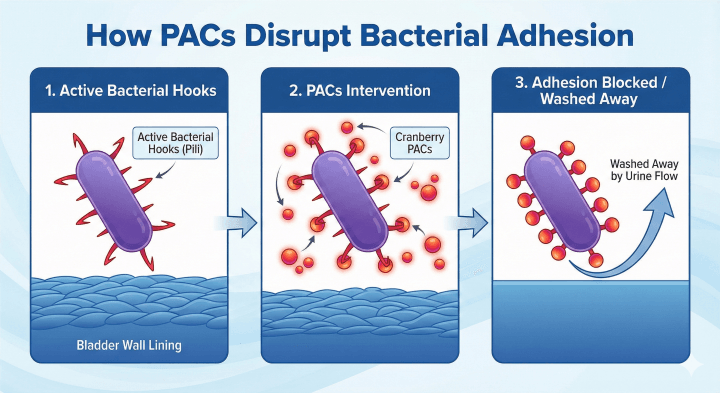
The three-panel diagram illustrates the mechanism where cranberry Proanthocyanidins (PACs) prevent bacteria from attaching to the bladder wall. Panel 1 shows a bacterium with active, sharp hooks approaching the bladder lining. Panel 2 demonstrates ‘PACs Intervention,’ where red PACs molecules bind to and cap the bacterial hooks. Panel 3 shows the neutralized bacteria being washed away by urine flow, unable to adhere to the lining.
The Science of Cranberry: Proanthocyanidins (PACs)
For decades, the prevailing myth was that cranberry worked by acidifying the urine, creating a hostile pH environment for bacteria. Modern biochemistry has largely debunked this as the primary mechanism. While cranberry is slightly acidic, it is physiologically difficult to consume enough to significantly and safely shift the pH of a dog’s bladder.
The real scientific breakthrough regarding cranberry’s efficacy centers on a specific group of bioactive compounds called A-type Proanthocyanidins (PACs).
PACs act as signaling disruptors and structural modifiers. Clinical research indicates that when adequate levels of A-type PACs are present in the urine, they chemically interact with the bacterial pili (the “hooks”). This interaction effectively changes the shape of the hooks or “caps” them, rendering them unable to bind to the bladder wall receptors.
By neutralizing the bacteria’s primary anchoring mechanism, PACs ensure that the organisms remain suspended in the urine, where they can be harmlessly washed away during normal voiding.
What the Clinical Data Says: Concentration Is Key
The identification of PACs as the active compound clarifies why generic cranberry products often fail in clinical applications: concentration matters.
Not all cranberry products contain therapeutically relevant levels of PACs.
- Cranberry Juice: Juice is predominantly water and significant amounts of fructose (sugar). The concentration of PACs is negligible, and the excess sugar can inadvertently provide a fuel source for bacteria.
- Generic Cranberry Powder: Many pet supplements use simple dried whole cranberry fruit. While “natural,” this contains all the fiber, skin, and sugar of the fruit, resulting in a low percentage of active PACs by weight.
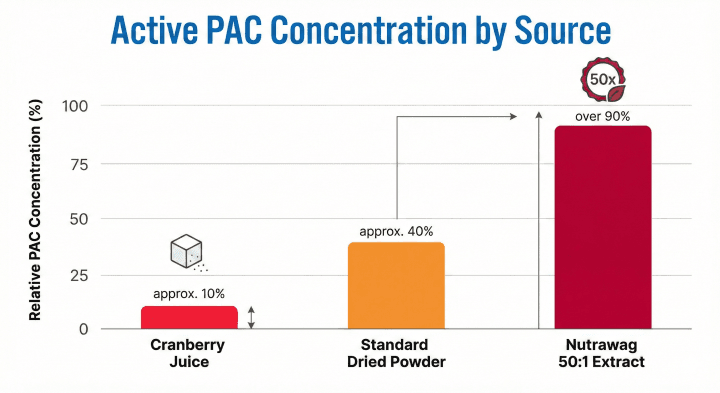
Active PAC Concentration by Source’, comparing the relative percentage of PACs in ‘Cranberry Juice’, ‘Standard Dried Powder’, and ‘Nutrawag 50:1 Extract’
Clinical data suggests there is a threshold dosage of PACs required to achieve the anti-adhesion effect. Below this threshold, the biological impact is minimal.
Why NutraWag Chose 50:1 Extract
To ensure NutraWag provides functional support rather than just label dressing, we utilize a high-potency 50:1 Cranberry Extract.
This extract ratio means that 50 kilograms of raw cranberry fruit are processed and concentrated down into a single kilogram of finished extract. This process removes the non-functional biomass — water, fiber, and sugars — and concentrates the bioactive A-type PACs to therapeutic levels.
By using a 50:1 extract, we can deliver a clinically relevant dose of PACs in a small, palatable serving, ensuring the biological mechanism of anti-adhesion is actually triggered.
Clinical Summary
- Mechanism over pH: Cranberry supports urinary health via anti-adhesion mechanisms, not by significantly acidifying urine.
- The Active Compound: A-type Proanthocyanidins (PACs) are the specific bioactive molecules that disable bacterial anchoring structures.
- The Velcro Analogy: PACs effectively “cap” the hooks on bacteria, preventing them from sticking to the bladder lining so they can be flushed out.
- Potency is Crucial: Juice and generic powders rarely contain enough PACs to be effective. A high-ratio extract (like 50:1) is necessary to achieve therapeutic concentration.
References
Scientific References
- Howell, A. B., et al. (2005). A-type cranberry proanthocyanidins and uropathogenic bacterial anti-adhesion activity. Phytochemistry, 66(18), 2281–2291.
Note: A landmark study identifying that it is specifically the “A-type” PACs found in cranberries, not B-type PACs found in other foods, that are responsible for preventing bacterial adhesion. - Gupta, K., et al. (2007). Cranberry Products Inhibit Adherence of P-Fimbriated Escherichia Coli to Primary Cultured Bladder and Vaginal Epithelial Cells. The Journal of Urology, 177(6), 2357–2360.
Note: This study provides direct evidence of cranberry’s ability to inhibit the specific “hook” mechanisms (fimbriae) used by uropathogenic bacteria. - Jepson, R. G., Williams, G., & Craig, J. C. (2012). Cranberries for preventing urinary tract infections. Cochrane Database of Systematic Reviews, (10).
Note: A major scientific review noting that while older studies focused on acidification, the current understanding is that the anti-adhesion mechanism of PACs is the primary biological activity. - Chou, H. I., et al. (2016). Effects of cranberry extract on prevention of urinary tract infection in dogs and on adhesion of Escherichia coli to Madin-Darby canine kidney cells. American Journal of Veterinary Research, 77(4), 421–427.
Note: A rare canine-specific study that demonstrated oral administration of cranberry extract significantly reduced bacterial adhesion in urine samples collected from dogs.
Disclaimer: These references are provided for educational purposes regarding the underlying biological mechanisms of ingredients and are not intended to imply specific clinical outcomes in dogs. While some fundamental mechanisms are conserved across species, citations may refer to human clinical studies or in vitro models where canine-specific data is limited.
Every milligram, on the label
Read it the way you read your own.
No proprietary blends. No combined “active mg” totals. Every active ingredient and its exact amount per 1 mL dropper—on the label, and on every product page.
| Ingredient | Amount |
|---|---|
| D-Mannose | 250 mg |
| Dandelion Leaf extract | 30 mg |
| Stinging Nettle extract | 30 mg |
| Cornsilk extract | 25 mg |
| Cranberry extract | 10 mg |
Non-medicinal: vegetable glycerin, reverse osmosis purified water, natural bacon flavour. VHP NN.R0G9.
| Ingredient | Amount |
|---|---|
| L-Theanine>99% pure isolate | 50 mg |
| German chamomile flower extractstandardized to 1.2% apigenin | 25 mg |
| Lemon balm leaf extractstandardized to 5% rosmarinic acid | 25 mg |
Non-medicinal: vegetable glycerin, reverse osmosis purified water, natural bacon flavour. VHP NN.W2S1.